After-Action Reviews (AARs) as a “Force Multiplier”
By: Thomas Henry MagnessFor the last two decades, I have been actively involved in helping develop some of the world’s top leaders. During my 4 years at the U.S. Army’s National Training Center (NTC) and the last 14 years with Thayer Leadership at West Point, one of the world’s premier leadership development organizations, I have experienced institutions emphasize the transformational power of the After-Action Review (AAR) to drive excellence – in leaders and in the teams they lead.
"At face value, it is a rather basic process – one of many tools that leaders use to improve performance and deliver results."
Yet simultaneously, it is easily the most effective, efficient, and high-impact “Force Multipliers” for adaptive and learning organizations, a DNA-level competitive advantage when fully optimized.
The Army cracked the code in the early 1980s when it fully integrated AARs as an inherent part of major training exercises and combat operations following the establishment of the NTC in Fort Irwin, California. These are not the post-mortem, corrective action meetings, project debriefs, or retrospectives that most businesses practice today. In the Army’s approach, leaders and the teams they lead at every level are challenged to seek improvement through facilitated conversations exploring ground truth and identifying areas where poor performance must be improved, and high performance sustained.
"Most importantly, it promotes accountability for implementing change, so the team is ready for the challenges ahead."
This same potential for transformative growth and performance excellence is available to any team or organization that similarly commits to the process. The following are key principles and best practices for optimizing the AAR and unlocking its full “force-multiplying” potential.
Baseline – After-Action Reviews
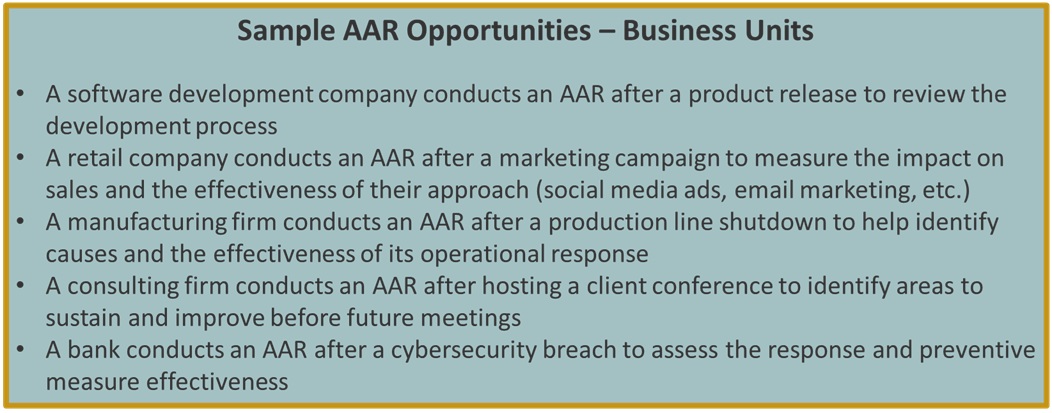
After-Action Reviews (AARs) are structured processes used by organizations to evaluate performance, identify lessons learned, and improve future outcomes. They are especially important for repeatable tasks or activities where a focused review can identify performance or process improvements for subsequent iterations. Just as every training mission or combat task provides an opportunity for AARs, every project, milestone, marketing campaign, crisis response, hiring action, or sales call serves as a potential platform for this growth-driver.
- AARs should be used to identify both what’s not working to standard and potential best practices worthy of scaling across the team.
- They should be completed immediately after an event/incident, while the lessons are fresh and passions are high.
- In certain circumstances, AARs can even be performed proactively in order to clearly identify best practices or adjustments as part of a continuous improvement process.
- All team members involved in the event/activity should be present, including those outside the group whose input is necessary to help address key issues.
Then, get after it!
AAR is a verb, with emphasis on the “Review.” Debate, challenge one another, and push to find solutions. (Note: when it becomes “After-Action Report,” i.e. a noun, you’ve missed the point!)
"There is no greater mechanism for TEAM learning – at all levels."
And be clear, no lesson is truly learned until it is put into immediate action. Find the earliest opportunity to implement key AAR outcomes to confirm the validity of the learning as no lesson is truly learned until it is tested and verified.
AAR Foundational Principles
AAR effectiveness revolves around understanding the following foundational principles. While anything less may still result in improvement, it will likely fall short as a legitimate force multiplier.
Principle #1:
The purpose of the AAR is to change the way we think. The past is the past. While we want to identify changes, improve best practices, and continually learn and grow, the deeper purpose is to prepare people for the next crisis, phase, project, hiring action, or sales call. We want people to think, make decisions, work cross-functionally, communicate, or prepare differently. Most certainly, the next event or driver for an AAR will be something different. All too often, AARs get relegated to simply “rearranging the deck chairs on the Titanic,” meaning, the ship is still sinking. Leaders must create an environment that forces teams to go deeper so they discover how to think and act differently.
Principle #2:
AARs are an accountability exercise. However, it’s accountability – going forward. This needs to be clear to all participants. If people thought they’d be accountable for the past, they certainly won’t be active participants (if they show up at all!) No one wants to admit to shortcomings if doing so will be held against them. On the contrary, the AAR focuses on holding people accountable for the changes they will make to adopt best practices, fix shortcomings, and think differently going forward.
Principle #3:
Standardize the template. Having a standard template helps to simplify the discussion because people know what to expect and are thus more willing to participate. Furthermore, the simple logic reinforces the idea of principle #2 – accountability going forward.
Opening Question: Were We Perfect? We do not open with subjective questions such as, “Were we good?” Or even, “Did we win?” Too often, those outcome bases will result in missed opportunities for improvement. Instead, asking “Were We Perfect?” points us back to our standard of perfection and, of course, the answer is always, “No.” The unanimity of that response should invite plenty to discuss, and no one should hold back.
Four Question Framework:
-
- What was the plan? What was supposed to happen during this project, meeting, sales call, etc.?
- What actually happened? What were the outcomes and how were they different from what we expected? After all, we weren’t perfect.
- What did we learn? What were the key lessons from the activity, process, or event being discussed? What went right, and how do we scale the applicable behaviors that made it so? What was less than perfect, and what adjustments must we make?
- What do we do with this information? This is where people commit. Do we need to update a process or SOP? Did we learn a different/better way to collaborate, make decisions, or communicate? Who will do that, and when? Do we need to share the lessons with other parts of the business? Who will commit to documenting it and communicating to the applicable groups?
AAR Best Practices
Consider the below best practices as guidelines for ensuring positive, actionable outcomes from your AARs. They will help turn these discussions into the transformative process the Army uses to drive continuous improvement.
While the Army often allocates up to 2 hours for AARs at the Training Center, it takes what it takes. Many/most AARs can fit within existing forums, rather than creating another meeting in an already-full schedule, and likely in a 30 to 60-minute duration. Bigger programs/projects or more strategic discussions may need more time, but every minute will have demonstrably high Return on Investment (ROI) for team performance and individual growth.
- AARs must be a facilitated conversation. Army AARs often leverage the skillset of trained, third-party facilitators; however, in the absence of that luxury, organizations must still identify someone to facilitate the discussion. Anything less is just a group of people chit-chatting. Effective facilitation prompts thoughtful questions, highlights key learning objectives, and involves the entire group. Leaders can use this as a development opportunity by utilizing someone with the necessary skills, while they remain focused on the higher-level lessons.
- Don’t boil the ocean. The intent of the AAR is not to solve everything all at once – that would be an almost impossibility in 30-60 minutes. Focus the AAR by identifying key issues in advance, allowing participants to come prepared to debate, complete lower-level AARs as necessary, and arrive equipped with data, issues, and their own lessons to share within the discussion. Similarly, don’t get carried away with too many adjustments. If focused on the important issues, one to three lessons and corresponding modifications will usually suffice.
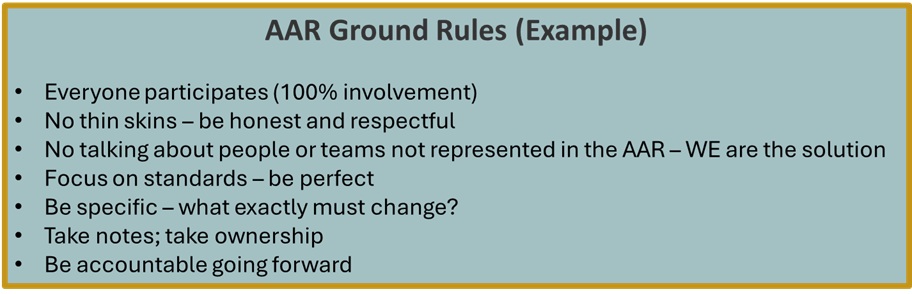
- Start with ground rules. Setting the tone is everything. Level-set all participants so they are in the right frame of mind, consistent with the spirit of this critical learning opportunity. The Army starts AARs with something like those shown in the text box above. Admittedly, the last one might be unique to Army AARs, but you get the point!
- Finish with accountability. Capture any/all commitments, and don’t end the AAR until all are acknowledged. Facilitators must conclude by reviewing, with specificity, who is doing what and by when. This is the only way to ensure learning is transformed into action going forward.
- Include cross-functional partners. Many of our issues and much of the friction in execution (military or not) occur on the boundaries between organizations or functions. In the military, armored units often struggle to synchronize with engineers or artillery. In the same way, pharmaceutical sales reps aren’t coordinate with medical leads or market access leaders within key accounts. Functional leaders may make assumptions and fail to properly contact key stakeholders during emergency response operations. For this reason, we include this idea as an important ground rule (see text box above) and invite those applicable representatives to the AAR. Undoubtedly, those partners are equally interested in resolving the issues. Get them there.
- Invite your boss. Army senior leaders truly value every opportunity to sit in the room and soak in the learning during AARs. Nothing is more impactful than hearing first-hand about challenges and best practices as this is how our leaders actively learn. Just as importantly, this collaboration is how lessons get transmitted across the boundary of different departments or levels of authority. Once equipped with lessons learned by attending the AAR, leaders are often best positioned to share this information as they conduct their “Battlefield Circulation (aka: Leadership by Walking Around).” So, bosses, communicate your interest in being invited to AARs, especially critical ones. Attend whenever you are able – to learn and to hold people accountable for conducting quality AARs.
- Be consistent: 1 AAR per week. Organizations who are not experiencing the transformative power of AARs may not be tapping into their full potential. Like any new skill, the best way to improve is to practice, practice, practice. There is no shortage of opportunities across any organization. If you get to Friday without that 1 rep, ask the team, “Did we have a perfect week?” Then, dig in.
- WENTK? Perhaps the critical question to discuss as part of question #4 in the AAR template above (What do we do with this information?), is asking, “Who Else Needs to Know (WENTK)?” Which other teams could benefit from what we have learned? How will we transmit it to them? Do those outside of our function gain from understanding our lessons? Does this need to go up the chain of command for higher visibility? Could stakeholders, customers, or partners benefit from us sharing our adjustments? Remember, being accountable for learning includes the communication of key lessons.
Moving forward, consider this information a success formula when it comes to effective AARs. The U.S. Army’s transformation into the most effective fighting force in the world was not because of new weapons, advanced technology, or a new generation of soldiers and leaders. It was the Army’s full commitment to the AAR and the cultural change it engendered at the DNA level for how to adapt and think differently. The same opportunity is available to any organization ready to go to the next level when it comes to learning and continuous improvement. True force multiplication through AARs. Get after it and Lead the Way!